
Mandatory labeling of products containing kratom
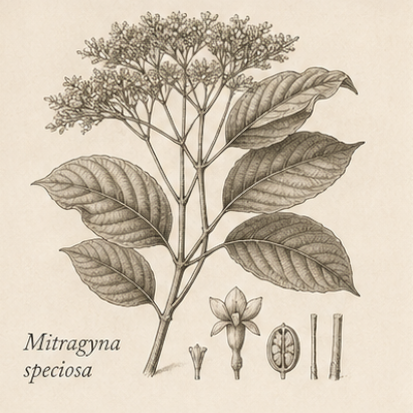
Mitragyna speciosa: botanical characteristics and taxonomy
In recent years, the tropical tree known as Mitragyna speciosa, commonly referred to as kratom, has become a widely discussed topic in the Czech Republic. For potential users, it is essential to understand this species not only from the perspective of its natural origin, but also through the strict legislative framework in the Czech Republic, which defines exactly what may legally be sold under this name and which parameters kratom products must meet. Since November 12, 2025, this species has officially been included on the list of psychomodulatory substances (PML), fundamentally changing the way it is characterized and regulated.
Systematic classification and legal definition
From a botanical perspective, Mitragyna speciosa belongs to tropical flora; however, within the context of the Czech market, its identity is primarily defined by narcotic substances legislation. Legislation requires that every product containing this plant be clearly labeled with mandatory information, which must appear together and may not be graphically separated.
The label must always begin with the designation “KRATOM”, followed by the product type, either “POWDER” or “EXTRACT”. Beneath this designation, there is also the kratom subtype (for traditional powder this includes 6 different colors, while extracts may include tablets, gummies, etc.). This systematic labeling serves for the immediate identification of the substance in accordance with Government Regulation No. 456/2025 Coll. For the end customer, this label is the first indication that the product is subject to state regulation and quality control.
Geographical origin and source transparency
From a botanical standpoint, Mitragyna speciosa is characterized as a tropical tree. For consumers, information about the geographical origin is important because it helps clarify the entire supply chain and is also a mandatory part of psychomodulatory substance labeling. According to current legislation, every individual and outer package must clearly state the country of origin, meaning the specific country where the plant material was cultivated.
The primary countries of origin commonly listed within documentation and distribution systems are Indonesia and Thailand. Within the “Plody Země” system, this information is closely connected with a strict traceability system. The batch number, beginning with the letter “L” followed by eight digits, is an identifier that is often assigned to the raw material already at the place of origin, for example directly during ordering from Indonesia.
The emphasis on declaring the country of origin ensures that botanical material can be reliably traced from a specific producer in Southeast Asia all the way to final processing and laboratory testing in the Czech Republic. Together with the manufacturer’s name, production date, and batch number, this information forms a unified data set defining the legal origin and identity of the plant on the market. Source transparency is therefore the foundation for the safe handling of this substance within the psychomodulatory substances regime.
Morphology and product forms
Plant material from Mitragyna speciosa reaches the market in several morphological forms, all of which must be clearly indicated on the packaging. The most common form is powder, consisting of dried and finely ground tree leaves. Another variant is the extract, a concentrated extract that may exist in solid or liquid forms such as tinctures or oils.
An interesting aspect of commercial subtype taxonomy is the color classification, which is typical for this species. Legislation recognizes six basic subtypes:
These colors refer to different leaf processing methods rather than different biological species. In the case of solid product forms (for example compressed powder), the law strictly mandates neutral geometric shapes such as circles, squares, or ovals. Any shapes resembling animals, fruit, or cartoon figures are prohibited to prevent the product from appearing attractive to persons under 18 years of age.
Chemical profile and active alkaloids
The botanical uniqueness of Mitragyna speciosa lies in its chemical composition, dominated by specific alkaloids. The most important among them are mitragynine and 7-hydroxymitragynine. These substances are subject to strict laboratory testing, which every batch must pass before being released for sale.
For standard 50 g packaging (the maximum permitted size for powder products), the following limits apply:
- Mitragynine: maximum 1,250 mg per package (concentration must not exceed 2.5% by weight).
- 7-hydroxymitragynine: maximum 50 mg per package (concentration up to 0.1% by weight).
For extracts, the limits are adapted to their concentrated composition, with mitragynine levels allowed up to 12.5% by weight. Every seller must possess a certificate from an accredited laboratory confirming that the specific batch does not exceed these legal limits.
Purity standards and safety testing
As with any natural material, Mitragyna speciosa carries a risk of contamination from external influences. Therefore, products undergo comprehensive laboratory testing focused on several critical areas:
- Heavy metals: Monitoring includes arsenic (limit 0.5 mg/kg), lead (3.0 mg/kg), cadmium (1.0 mg/kg), and mercury (0.1 mg/kg).
- Microbiology: Total microorganism count (TMC), molds, yeasts, and E. coli bacteria are monitored. The presence of Salmonella bacteria must be negative in a 25 g sample.
- Mycotoxins and PAHs: Testing includes aflatoxins and polycyclic aromatic hydrocarbons, which may arise from improper drying or storage.
The results of these tests guarantee that the plant material is pure and complies with the requirements of Decree No. 448/2025 Coll.
Storage and preservation of plant material
To preserve the botanical properties of ground Mitragyna speciosa leaves and prevent degradation, specific storage conditions must be maintained. The powder is highly hygroscopic, meaning it absorbs moisture from the environment. If relative humidity exceeds 60%, there is a significant risk of mold and yeast growth.
The temperature should remain stable and ideally not exceed 25 °C. Higher temperatures and direct sunlight accelerate the degradation of active alkaloids. For this reason, opaque packaging with protection against UV radiation and moisture is recommended. Such packaging must also include child-resistant features and a tamper evidence element confirming that the package has not been opened prior to purchase.
Mandatory information for users
In addition to botanical and chemical data, every package must contain additional mandatory information referred to by legislation as “Consumer Information”. This text is strictly defined by regulation and includes warnings regarding the psychoactive nature of the substance, statements that it is neither a food nor a medicinal product, and instructions for safe handling.
An integral part is also the health warning, which must cover at least 30% of the package surface: “Use of this product may damage your health. Follow the consumer information.” These details provide customers with clear information about the properties of the plant, its limits, and safe storage practices. As a result, the product becomes more transparent.