
Post-harvest processing of kratom
Legislative definition and technical parameters of the plant matrix
The plant Mitragyna speciosa, within the legislation of the Czech Republic classified as a psychomodulatory substance (PML), has been subject since 12 November 2025 to a strict regulatory regime under Government Regulation No. 456/2025 Coll. Technological processing of kratom must comply with the requirements of Decree No. 448/2025 Coll., which defines the permitted product form as a dried ground plant, powder, or extract. In terms of physical parameters, this is a plant matrix where emphasis is placed on fineness of grinding and batch homogeneity, while the unit package weight for solid form must not exceed 50 g in the final product.
Decontamination and stabilization of batches using gamma radiation
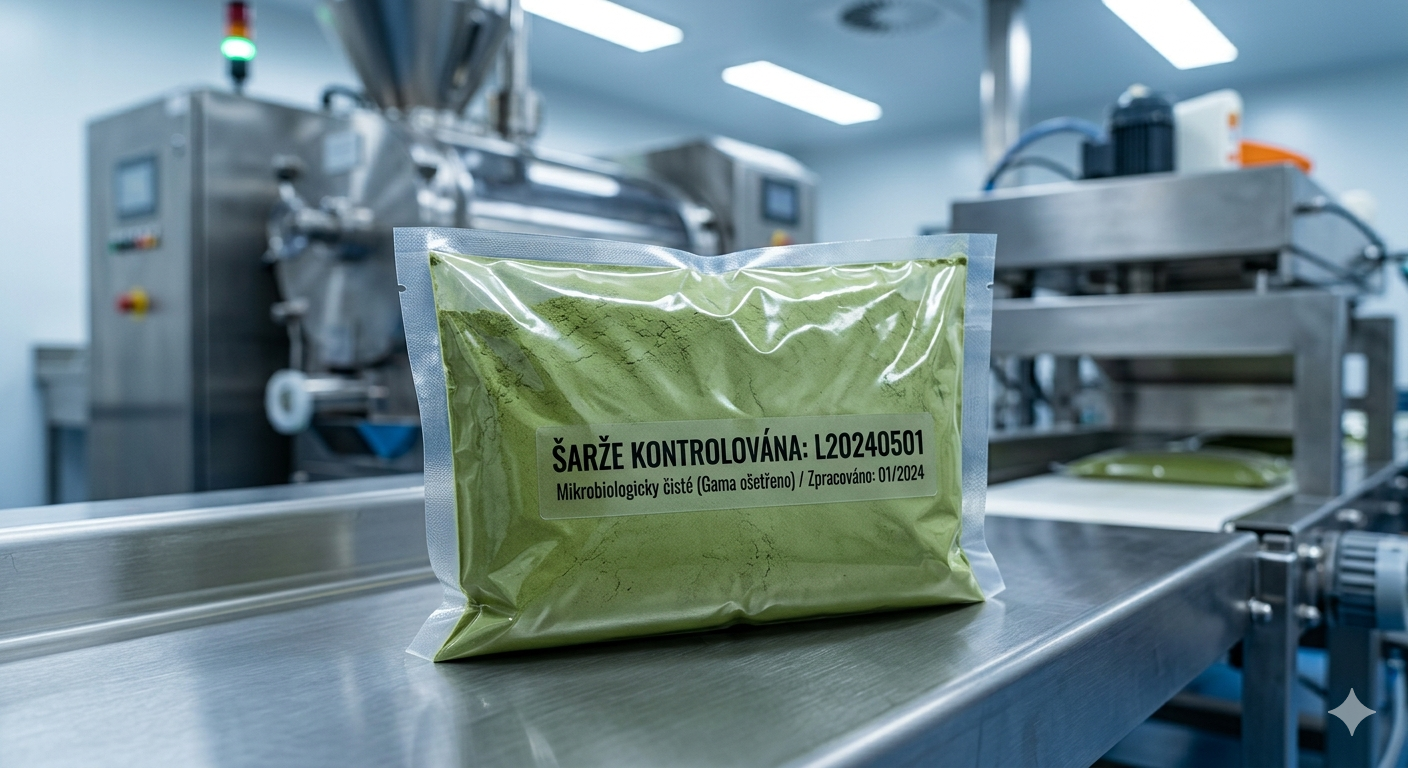
A key element of the technological process after harvesting and drying kratom is ensuring microbiological stability of the plant material. Due to the natural origin of the raw material, it is necessary to eliminate the risk of pathogenic organisms. The standard of Plody země is the use of sterilization using gamma radiation. This process is suitable for achieving legally defined microbiological limits, where batches must test negative for bacteria of the genus Salmonella and show E. coli values below 100 CFU/g. The total microbial count (TMC) must not exceed 10^7 CFU/g.
Technological processing procedure: From dry material to fine matrix
The process of transforming raw kratom leaves into the final product involves several stages of mechanical processing. After primary drying and possible fermentation, the leaves are ground into a fine powder matrix. The technological equipment must be set so that the resulting consistency meets the standards for loose PML substances. During grinding, the priority is to preserve the concentration of active compounds, namely mitragynine and 7-hydroxymitragynine. According to Decree No. 448/2025 Coll., the mitragynine content in a unit package must not exceed 2.5%, and for 7-hydroxymitragynine the limit is set at a maximum of 0.1% by weight.
Standard operating procedure (SOP) for handling and sealing
The production itself, defined as repackaging from bulk vacuum bags of 1 kg into unit packaging, is carried out according to the strict protocol PR-SOP-001. Before entering production areas, transport bags are disinfected using 99% isopropyl alcohol. Personnel are required to use protective equipment, including coats, gloves, hair and beard nets, and respirators.
Filling is carried out either manually or using a semi-automatic auger dosing system with an integrated scale. The target weight of each package is set within a tolerance of 49.7 – 50.0 g. After filling, the sealing process follows, where the doypack is closed and hermetically sealed using a pulse or continuous sealer. Each package must include a tamper-evident element proving it has not been opened before sale.
Protocols for handling technological deviations and non-conforming products
Any deviation from the standard procedure must be recorded in form PR-F-003. In case of matrix integrity breach (product spillage), the material must be immediately weighed, recorded as waste, and placed in a designated hazardous waste room. If during control weighing the weight exceeds 50 g, recalibration of the dosing machine follows and the product is repackaged. To prevent cross-contamination between batches, a special vacuum cleaner dedicated exclusively to production areas is used, and thorough sanitation of all machine components is performed.
Quality verification and laboratory control of output parameters
Each batch placed on the market must be accompanied by a certificate from an accredited laboratory, such as UCT Prague (BAFA laboratory) or the National Institute of Public Health (SZÚ). In addition to alkaloid content, analysis includes screening for contaminants. The following heavy metal limits are mandatory: arsenic (max 0.5 mg/kg), lead (max 3.0 mg/kg), cadmium (max 1.0 mg/kg), and mercury (max 0.1 mg/kg). Absence of aflatoxins and the concentration of polycyclic aromatic hydrocarbons (PAHs) are also verified, with a limit set at 0.05 mg/kg.
Traceability system and archival of production samples
To ensure maximum transparency, each batch is assigned a unique code in the format “L + 8 digits”. This code is assigned already at the time of raw material ordering in the country of origin (e.g. Indonesia) and accompanies the product throughout the entire production and documentation process until the final consumer. From each completed production run, a sample is taken for archiving, documented in sample collection records (HS-F-005) and production records (Batch record PR-F-002). All documentation related to production and batch testing must be retained for a minimum of 5 years.